Farm Futures
   Search Site:  Search Site Saturday, May 25, 2013 | Bookmark This Site   
Skip Navigation Links
Home
Markets
News
Weather
Farm Futures NOW!

Magazine Online
RSS News
Mobile
Subscribe
Reprints
Register
Login
About Us
Advertise
 
  • Post to Your Wall.
 

Old Man River Showing His Age

Agriculture faces severe problems ahead from stalemate on upgrades to the inland waterway system and farm exports could drop 12.4%
Jacqui Fatka 
Published: Mar 8, 2012

More than half of the structures that are part of the U.S. inland waterway system for river barge shipping exceed their 50-year usable lifespan, according to a recent soybean checkoff-funded report. More than one-third surpass 70 years of age, a concern because major rehabilitation is usually necessary to expand the typical lifespan from 50 to 75 years.

"Should a waterway be closed due to one or more lock failures, the resultant increase in costs that would be incurred in utilizing truck or rail transportation would decrease or even eliminate the cost advantage of U.S. Midwestern producers. This would be especially detrimental to export shipments," the report notes.

The report identifies a failure at any one of the focus locks would cost agricultural producers anywhere between $900,000 and $45 million, and result in lost revenues to barge companies between $2.2 million and $162.9 million, depending on duration.

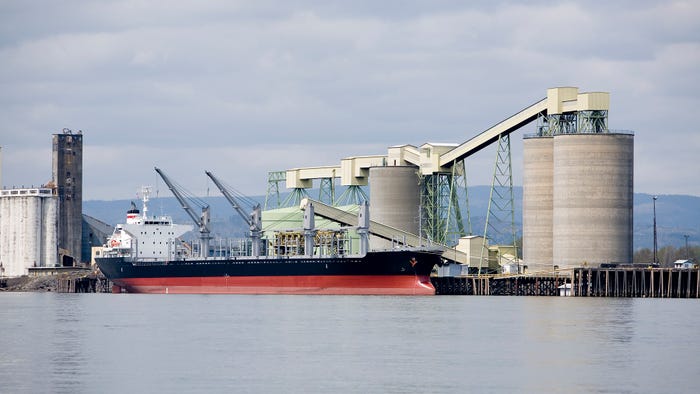
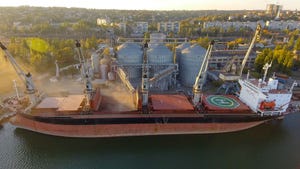
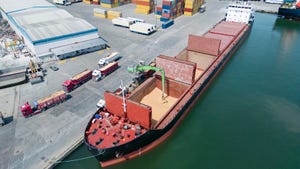
The U.S. inland waterways represent key infrastructure for transporting U.S. soybeans. Up to 89% of soybeans exported through the lower Mississippi ports, such as the Port of New Orleans, arrive at those ports in barges that must transit multiple locks for the trip downstream. From 2005 through 2009, 87–91% of corn exported through lower Mississippi ports arrived at the ports via barge, the report states.

The average monthly value of corn and soybeans handled at each lock during the 2000–2010 period was $59.6 million and $40.3 million for the Upper Mississippi River, $20 million and $11.7 million for the Illinois River, and $8.9 million and $13.1 million for the Ohio River.Read the full report at www.unitedsoybean.org/wp-content/uploads/Americas_Locks_And_Dams.pdf.

Dredging issues

Due to record flooding in the central U. S. in 2011, approximately 60 million cubic yards of sediment (enough to fill the Superdome 13 times) will need to be removed from the shipping channel - compared to 36 million cubic yards in a typical year.

A lack of federal funding for maintenance dredging by the U.S. Army Corps of Engineers has led to draft restrictions that limit the size of ships that can operate on the Mississippi River. These draft restrictions limit transportation efficiency, impacting trade and hurting the U.S. economy by increasing the cost of moving key commodities on the river including soybeans, petroleum, coal and other industrial cargoes.

A recent study shows that agricultural commodities will be the most affected by draft reductions brought on by reduced dredging on the Mississippi River. The study, commissioned by the Big River Coalition and conducted by economist Tim Ryan, calculates the impacts that draft reductions have on the economy.

Ryan's analysis found that if the controlling depth is reduced to 38 feet of draft, the nation and the world stand to lose 12.38 million tons of exports (12.4% of the total) and 5.87 million tons of imports (5.5% of the total). The most affected export commodities are soybeans and other agricultural products, and most of the impact or loss for imports will be in the form of crude oil destined for the refineries along the Mississippi River.

The report found that if producers are forced to absorb higher transportation costs, it will require additional costs to ship in bulk. For instance the additional bulk ship of 55,000-ton capacity for a trip from New Orleans to China would be, on average $1,983,316 and producers would bear that additional cost.

In just one year, American producers, mostly farmers, could lose $445.15 million in direct losses in production, the study estimates. The ripple effect, or secondary spending effect, could add another $414.11 million, bringing the total loss to the U.S. economy of the reduced dredging to $859.25 million in lost production.  

The full report and the executive summary can be found on the Big River Coalition website at http://bigrivercoalition.org/news.html.  

Cost to Agricultural Producers of Lock Closures (Thousand USD).

Old Man River Showing His Age

Old Man River Showing His Age


Permalink: Click here

Tagged: checkoff, soybean checkoff

Comments
Read comments from others and share your own thoughts.
Please provide the answer to the following question:

 = 
 
Search this site:   

Read More Stories
Ag Already Impacted by Climate Change
Read this storyEfforts should move toward mitigation and adaptation, say experts.

Read this story

Testing the Waters
Read this storyProject identifies fields at risk for sending phosphorous to streams.
Read this story

Agriculture's Aerial Patrol
Read this storyUnmanned drone technology may be next step for crop and grassland scouting.
Read this story

   
Morning Market Review by Bryce Knorr
Afternoon Recap by Paul Burgener
Weekly Corn Review
7 Things You Might Have Missed this Week
Weekly Soybean Review
Weekly Wheat Review
Economic Nitrogen Fertilizer for Corn
Sharing the Farm Equipment Load
Super Farm Planning Tool
CRP Decisions Made Simple
Top 50 Tags
2008 farm bill 4-H American Farm Bureau Federation American Soybean Association animal health biofuel biofuels BSE checkoff Corn Belt crop insurance department of agriculture Drought dryland Environmental Protection Agency EPA extension service farm bill Farm Bureau farm programs farm progress farm progress show Farm Service Agency farm show farmprogress farmprogress.com farmprogressshow farmprogressshow.com FFA Food and Drug Administration free trade agreement hay expo House Agriculture Committee husker harvest Husker Harvest Days huskerharvestdays.com livestock livestock producers National Cattlemen's Beef Association National Corn Growers Association NCBA NCGA New York Farm Show Progress show Senate Agriculture Committee soybean association the farm bill usda winter wheat www.farmprogress.com