Farm Futures
   Search Site:  Search Site Saturday, May 25, 2013 | Bookmark This Site   
Skip Navigation Links
Home
Markets
News
Weather
Farm Futures NOW!

Magazine Online
RSS News
Mobile
Subscribe
Reprints
Register
Login
About Us
Advertise
 
  • Post to Your Wall.
 

Huge Threats to U.S. Agriculture Are Manmade and Avoidable

Ag Secretary Tom Vilsack urges constituents to pressure law makers to avoid sequester, plus pass a new food, farms and jobs bill.
John Otte 
Published: Feb 21, 2013

U.S. Secretary of Agriculture Tom Vilsack acknowledged that last year's drought focused a lot of attention on managing and mitigating risks farmers cannot control as he led off USDA's 2013 Agricultural Outlook Forum on managing risk in the 21st century. The big uncontrollable risk is weather.

Vilsack immediately shifted to discussing manmade risks.

"Uncertainty with respect to the federal budget and the pending sequester, if unresolved, will impact every American," he declared. "If March 1 comes, and no action is taken, every line item of our budget will have to be reduced by somewhere near 5% to 6% on a fiscal year basis. We must implement the cuts over the remaining portion of the fiscal year, which effectively equates to 10% to 12% cuts for the rest of the current fiscal year.

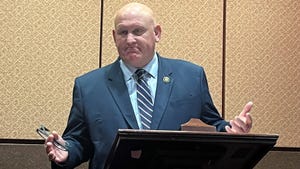
Ag Secretary Tom Vilsack urges constituents to pressure law makers to avoid sequester, plus pass a new food, farms and jobs bill.

Ag Secretary Tom Vilsack urges constituents to pressure law makers to avoid sequester, plus pass a new food, farms and jobs bill.
"Congress has written a direct prescription to reduce every line item by the same amount," he adds. Agencies where almost all lines involve people have very little flexibility. Cuts in food safety inspections will impact all food processing plants and all consumers.

"Congress can avoid the sequestration by agreeing on cuts," stated the Secretary. He suggested Outlook Forum participants should contact their legislators and urge them to act.

"Congress can solve the problem," he reiterated. "If Congress fails to act, USDA will do what we have to do to cut spending. If we do not, civil and possibly criminal penalties may apply. This is a risk that is manmade."

Suppose lawmakers dodge this manmade crisis.

"The same thing could happen again on March 27," noted Vilsack. "If congress fails to come to budget agreement by that date, all government activity will come to halt. Such a shutdown would impact ag credit availability, food inspections, export programs--virtually everything government does."

Lack of farm bill adds more manmade uncertainty

"Not having a five-year farm bill creates uncertainty on the part of farmers as to what the safety net will be if we have another drought," says Vilsack. "No bill means livestock producers have no assistance similar to what was available under the expired legislation.

"I refer to it as the food, farm and jobs bill," stated the secretary. "We are a nation that feeds itself. A food, farm and jobs bill makes us a stronger and more secure nation

"However, if we are to create vibrant rural communities we need to compliment food production with other agricultural processing activities and promote development of renewable source of energy and bio-economy products in rural America," he says. "Those advances are all possible. Passing a new five-year food, farm and jobs bill can help make them possible and do it sooner."

Labor uncertainty creates ag risk

Agriculture needs labor. "Everyone in this room understands that not all of that labor is legal," Vilsack told forum participants. "It is important to have immigration reform. We need a comprehensive set of reforms that secure our borders, put responsibility on folks who are here to pay penalties and pay back taxes and get on the path to be here legally.

"Doing so will help keep us on the path of having the most reasonably-priced food in the world," he stated. "Here 10% of paycheck goes to food. Consumers in other countries spend 20%, 30%, 40% and in some cases 50% of their earnings on food.

"All of these are manmade risks to agriculture and can be solved if Congress will do its job," declared Vilsack.

Some manmade risks—specifically trade barriers--will need international assistance to solve.

U.S. livestock markets face pressure from China moving toward third-party testing of pork shipments from the U.S. to verify meat is free of the feed-additive ractopamine, which is used to produce lean muscle in hogs instead of fat.

Japan recently shifted to allow imports of beef from animal up to 30 months of age. Mexico and Hong Kong are also considering relaxing some restrictions which would open a wider market for U.S. beef.

None of this would be possible without congressional action to empower U.S. negotiators to negotiate and without co-operation from international trading partners.


Permalink: Click here

Tagged: usda, livestock, farm bill, Drought, livestock producers

Comments
Read comments from others and share your own thoughts.
Please provide the answer to the following question:

 = 
Why do we need federal, state, and county health inspectors? One should be enough.
shar on 2/25/2013 12:59:00 PM
Yes we have CHEAP food - as my customers, I prefer QUALITY food. This pursuit toward and ever lower price product at the expense of the environment, public health and national budget must stop. As in any business farmers will provide what the customers desires or do something else! Finally the USDA must be severely cut back by at least 50% eliminating most/all of the political positions.
Anonymous on 2/22/2013 11:05:00 AM
I think this is very confusing.
Anonymous on 2/21/2013 8:35:00 PM
I agree. Some of the pencil pusher jobs could be furloughed, but that would not create the crisis that laying off meat inspectors would
Anonymous on 2/21/2013 2:36:00 PM
American farmers are generally the best trained, best educated, most experienced and innovative of farmers anywhere. I believe they need less government control, less government help and totally less government involvement in their business and lives. No one can manage the American farm better than the American farmer. In the past, some American aggro-businesses have lobbied for various taps on the American taxpayer. Now is the time to begin to phase out to regulation and support to relieve the American farmer and the American taxpayer. Jim in Mesa, AZ - not a farmer, just a concerned citizen

Anonymous on 2/21/2013 1:50:00 PM
I agree with you comment 10:37 the USDA as well as all government agencys need to do the same. its time to stop borrowing money from China to keep our economy going,, take the cuts across the board this country will survive we have in the past .
Anonymous on 2/21/2013 12:45:00 PM
sounds like the USDA needs to reorganize into a more efficient and streamlined organization with emphasis on making middle and upper management more productive. Just like in private industry the middle and upper management levels end up over staffed over time and massive corrections are in order. My guess is that doing so would eliminate the need for (laying off) meat inspectors for a time. Probably could do other things as well such as a salary reduction like private industry did, How about reforming the pension plans like private industry also did. Need I go on????
Anonymous on 2/21/2013 10:37:00 AM
 
Search this site:   

Read More Stories
7 Things You Might Have Missed this Week
Read this storyImpressive planting progress, country of origin labeling and a moveable 'rain' shed
Read this story

CBO Releases Cost Estimate for House Ag Committee-Passed Farm Bill
Read this storyCongressional Budget Office estimates Farm Bill will fall short of projected $40B in deficit reduction
Read this story

Senate Farm Bill Debate Marches On
Read this storySenators tackle four amendments on day four of Farm Bill debate; wrap up discussion until June 3
Read this story

   
Morning Market Review by Bryce Knorr
Afternoon Recap by Paul Burgener
Weekly Soybean Review
Weekly Wheat Review
Weekly Corn Review
7 Things You Might Have Missed this Week
Super Farm Planning Tool
Chinese Soy Ceremony in Iowa
CRP Decisions Made Simple
Sharing the Farm Equipment Load
Top 50 Tags
2008 farm bill 4-H American Farm Bureau Federation American Soybean Association animal health biofuel biofuels BSE checkoff Corn Belt crop insurance department of agriculture Drought dryland Environmental Protection Agency EPA extension service farm bill Farm Bureau farm programs farm progress farm progress show Farm Service Agency farm show farmprogress farmprogress.com farmprogressshow farmprogressshow.com FFA Food and Drug Administration free trade agreement hay expo House Agriculture Committee husker harvest Husker Harvest Days huskerharvestdays.com livestock livestock producers National Cattlemen's Beef Association National Corn Growers Association NCBA NCGA New York Farm Show Progress show Senate Agriculture Committee soybean association the farm bill usda winter wheat www.farmprogress.com