Farm Futures
   Search Site:  Search Site Wednesday, May 22, 2013 | Bookmark This Site   
Skip Navigation Links
Home
Markets
News
Weather
Farm Futures NOW!
Magazine Online
RSS News
Mobile
Subscribe
Reprints
Register
Login
About Us
Advertise
 
  • Post to Your Wall.
 

Cotton Industry Expects More WTO Pressure

NCC President blasts WTO Hong Kong action, citing hypocrisy.
Dan Crummett 
Published: Jan 5, 2006

Expect intense pressure over the next four months to extract even more concessions from the U.S. and its cotton industry in trade talks with the World Trade Organization.

That's the assessment from Mark Lange, president and CEO of the National Cotton Council, who minced few words Thursday in his report on the recent WTO action in Hong Kong singling out cotton - particularly U.S. cotton - for reduced domestic and export support. 

Lange, spoke to the general session of the 2006 Beltwide Cotton Conferences in San Antonio, where more than 3,500 members of the U.S. cotton industry have gathered for talks on production, marketing, research and policy. 

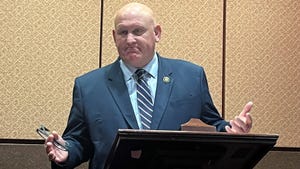
Mark Lange, president and CEO of the National Cotton Council says the U.S. cotton program is being punished for all of the world's economic ills by WTO action in Hong Kong.

Lange, an economist, blasted the WTO for failing to address all agricultural trade as a single issue in favor of holding cotton supports up as what he called "the root of all evil." He also unveiled a number of scenarios in which China has operated with impunity to WTO rules and regulations and has received no censure from the world body.

"It's easy to find annual U.S. spending figures of $2- to $3-billion for the cotton program—particularly from a year with low market prices—and wave it as prima facia evidence of damage..." to developing countries "and then blame the overbearing, culturally bereft Americans for all of the world's ills," Lange charged.


He then asked, "How much was spent in China alone annually between 1998 and 2005 to add 25 million bale equivalents of polyester production, and 22 million bales of spinning capacity? That infrastructure investment (by China's government) is staggering in size—easily exceeding $2- to $3-billion annually," he charged. "Much of that was done with non-producing loans, still, WTO turns a blind eye to this development."

Additionally, Lange notes China, India and Pakistan have moved from spinning 44.6 million bales of cotton five years ago to spinning 72 million bales per year today. "That accounts for 63% of the world's spinning," he explains. "And that was done as China was paying record high prices for cotton on the world market!

"In 2004, Chinese mills paid about 74 cents per pound for cotton while the world's 'A' index was 62 cents. How do they pay an average of 18% more for their cotton than the rest of the world and take business from everyone else?," he asked.

In addition, Lange says China's expansion in textile capacity comes at the expense not only of the EU and the U.S., but of the lesser developed countries that are complaining the loudest about U.S. price supports. "The non-government agencies advocating for these nations and the WTO seem to turn a deaf ear to these developments," he adds.

The Hong Kong Agreement

 WTO talks in Hong Kong recently concluded:

  • All forms of export subsidies for cotton will be eliminated by developed countries in 2006.
  • Developed countries will give duty free and quota free access for cotton exports from least-developed countries from the beginning of the implementation period.
  • And, that cotton subsidies will be reduced "more ambitiously" than whatever the general formula of the final agreement sets forth.

Lange says this "defies logic."

First, he explains, it says we'll [the U.S.] drop all subsidies before we develop an agreement.

Second, he notes, the duty free and quota free access to EU and U.S. markets frees up only 8% of the spinning capacity, but doesn't include China. "China is a self declared developing country," Lange notes, adding, "but they have nuclear arms and a space program."

Third, he says the U.S. cotton Industry is deeply concerned about being singled out, but adds the situation is an ominous warning to other commodities. How does a single commodity stand up to the world organization•how can bananas, corn or wheat stand up to the world's economy?

Between now and April 30, negotiators will continue working as WTO polishes its work in Hong Kong with specific figures, Lange explains. During that time he said NCC will work with U.S. trade representative and USDA to counter efforts to further isolate and "discipline" cotton.

Still, he says, despite the U.S. eliminating Step 2 cotton payments and the subsidies under the GSM payments, WTO representatives and NGO's representing lesser-developed nations will continue to ask for more—regardless of concessions already made and U.S. development activities underway in Africa.


Permalink: Click here

Tagged: usda, farmprogress, farmprogress.com, www.farmprogress.com

Comments
Read comments from others and share your own thoughts.
Please provide the answer to the following question:

 = 
 
Search this site:   

Read More Stories
Sugar Policy, SNAP Key Points of Farm Bill Debate Day Two
Read this storySenators debated sugar policy and voted on controversial SNAP amendments Tuesday
Read this story

U.S. Geological Survey Finds Groundwater Levels Shrinking
Read this storyLatest study on long-term aquifer water levels finds accelerating draw-down
Read this story

Weekly Fertilizer Review
Read this storyPlanting rush doesn't alter fertilizer dynamics.
Read this story

   
Morning Market Review by Bryce Knorr
Afternoon Recap by Paul Burgener
Weekly Fertilizer Review
Sugar Policy, SNAP Key Points of Farm Bill Debate Day Two
U.S. Geological Survey Finds Groundwater Levels Shrinking
The Buzz: Late Planting Still An Issue
Senate Begins Consideration of 2013 Farm Bill
CRP Decisions Made Simple
Sharing the Farm Equipment Load
Make Smarter Land Investments
Top 50 Tags
2008 farm bill 4-H American Farm Bureau Federation American Soybean Association animal health biofuel biofuels BSE checkoff Corn Belt crop insurance department of agriculture Drought dryland Environmental Protection Agency EPA extension service farm bill Farm Bureau farm programs farm progress farm progress show Farm Service Agency farm show farmprogress farmprogress.com farmprogressshow farmprogressshow.com FDA FFA Food and Drug Administration free trade agreement hay expo House Agriculture Committee husker harvest Husker Harvest Days huskerharvestdays.com livestock livestock producers National Cattlemen's Beef Association National Corn Growers Association NCGA New York Farm Show Progress show Senate Agriculture Committee soybean association the farm bill usda winter wheat www.farmprogress.com