Farm Futures
   Search Site:  Search Site Monday, May 20, 2013 | Bookmark This Site   
Skip Navigation Links
Home
Markets
News
Weather
Farm Futures NOW!

Magazine Online
RSS News
Mobile
Subscribe
Reprints
Register
Login
About Us
Advertise
 
  • Post to Your Wall.
 

The Conditions Are Right For Aflatoxin

A mycotoxin produced by Aspergillus flavus has the potential to limit yield quality this season.
Janell Baum 
Published: Jul 31, 2012

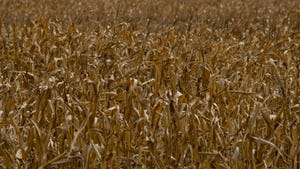
Hot, dry growing seasons and warm summer nights aren't just devastating for the development of corn; they can also lead to the development of Aspergillus ear rot, and the potential for aflatoxin contamination.

Aflatoxin, a mycotoxin produced by the fungus Aspergillus flavus, shows itself as a yellow-green or gray-green mold on corn kernels. Prolonged hot and dry conditions post-pollination increase the possibility of aflatoxin production.

Alison Robertson, plant pathologist at Iowa State University, says aflatoxin requires nights with temperatures greater than 70 degrees and days with temperatures greater than 86 degrees to effectively develop.


Yellow-green powdery growth of Aspergillus flavus on a corn rootworm-damaged ear. (Photo courtesy Alison Robertson, Iowa State University)

Yellow-green powdery growth of Aspergillus flavus on a corn rootworm-damaged ear. (Photo courtesy Alison Robertson, Iowa State University)
Often confused for aflatoxin, vomitoxin is produced during cool, wet growing seasons. It likely poses no threat for this growing season.

Aflatxoin, however, is a known carcinogen, and the Food and Drug Administration lists the highest possible aflatoxin content as 20 ppb for the human food supply. For finishing cattle, that content may go no higher than 300 ppb.

University of Illinois Plant Pathologist Carl Bradley says that though this season's prevalence of aflatoxin is currently uncertain, those levels are something to keep in mind.

Dried distillers grains, which are often used as feed for livestock, may be affected by aflatoxin content. "Toxins become even more highly concentrated in the distillers grain," Bradley says, "and [ethanol plants] sell those distiller's grains as feed."

For farmers concerned about the prevalence of aflatoxin, both pathologists say scouting, in early stages, is a sufficient method of testing. Bradley says the most susceptible areas are likely the most stressed - those at the top of hills, and areas with lighter soil.

Robertson recommends that farmers select eight to 10 locations per field and peel back the husks of 10 ears per location. A visual check for the tell-tale green-gray mold will determine next steps.

She said if ear rot is present on more than 10% of the ears examined, the field is at risk for aflatoxin contamination. Though corn is just reaching dent stage, making it unclear if aflatoxin will be a big threat this summer, Bradley says the conditions are certainly right.

"Right now, we are in a holding pattern on if it's going to be an issue or not," Bradley says. "We have certainly had some conditions that would be favorable for it. I haven't heard of anybody reporting it, but I wouldn't be surprised if it were out there."

If it is found, Bradley says, aflatoxin has very few management tools. One option requires application before silking, which renders it useless at this point.

Bradley adds that the only other tool growers have is irrigation, which may help limit aflatoxin development, but he said it really boils down to paying attention. "There's not a lot of management a grower can do other than be aware," says Bradley. "We don't have good management tools."

If producers find suspected aflatoxin contamination, they are encouraged to contact their insurance agent and make preparations for harvest. If they are unsure about a diagnosis, Bradley recommends contacting an extension agent or preparing samples for independent testing.
Robertson adds that aflatoxin-contaminated corn is best harvested early and cooled quickly. She says limiting damage to the kernels will help keep the toxin from spreading.



Permalink: Click here

Tagged: livestock, Food and Drug Administration, mycotoxin

Comments
Read comments from others and share your own thoughts.
Please provide the answer to the following question:

 = 
 
Search this site:   

Read More Stories
Moving on Up with Corn Planting, That Is
Read this storyLooks like we have the tools and talent to cover the territory if the ground dries out.
Read this story

ACRE, DCP Deadline Approaching
Read this storyUSDA's Farm Service Agency reminds farmers and ranchers that ACRE deadline is June 3; DCP deadline is August 2.
Read this story

St. Louis Fed Finds Q1 Farm Income Higher Than Expected
Read this storyLenders worry weak economy and high input costs will be biggest hurdle
Read this story

   
Morning Market Review by Bryce Knorr
Afternoon Recap by Paul Burgener
Planting Delays Return After Open Week
ACRE, DCP Deadline Approaching
Moving on Up with Corn Planting, That Is
Economic Nitrogen Fertilizer for Corn
Weekly Corn Review
Livestock Call by John Otte
Weekly Fertilizer Review
Weekly Soybean Review
Top 50 Tags
2008 farm bill 4-H American Farm Bureau Federation American Soybean Association animal health biofuel biofuels BSE checkoff Corn Belt crop insurance department of agriculture Drought dryland Environmental Protection Agency EPA extension service farm bill Farm Bureau farm programs farm progress farm progress show Farm Service Agency farm show farmprogress farmprogress.com farmprogressshow farmprogressshow.com FDA FFA Food and Drug Administration free trade agreement hay expo House Agriculture Committee husker harvest Husker Harvest Days huskerharvestdays.com livestock livestock producers National Cattlemen's Beef Association National Corn Growers Association NCGA New York Farm Show Progress show Senate Agriculture Committee soybean association the farm bill usda winter wheat www.farmprogress.com