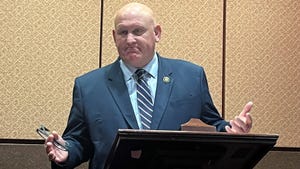
The House prepares to head home and when asked whether a farm bill extension was on the schedule House Speaker John Boehner said, "We will deal with the farm bill after the election."
The statement was another nail in the coffin following the official schedule released earlier this week from House Majority Leader Eric Cantor which did not show a vote on the farm bill this week before Congress recesses in the month leading up to the November elections.
Boehner said it has not been decided whether the House will tackle the full farm bill or just an extension.
"The current situation that we face is that we’ve got people who believe there’s not enough reform in the Farm Bill that came out of committee. We’ve got others who believe there’s too much reform in the bill that came out of the committee. In our opinion leaving less than 218 votes to pass either an extension or to consider the entire farm bill," he told reporters Sept. 20. "But when we get back we will deal with the issue of the farm bill." National Farmers Union (NFU) president Roger Johnson saidhe was confident there were enough votes to pass the farm bill and "strongly" urged the Speaker to reconsider the recess and "take up the bill and deal with it now."
Johnson said while the announcement from Boehner does not come as a surprise, "punting the farm bill into the lame duck session is a transparent political maneuver that leaves rural America holding its collective breath about its livelihood and future."
Congress now must deal with significant tax and funding issues during the lame duck session and Johnson worried the farm bill may become a "pawn in that process."
Secretary of Agriculture Tom Vilsack has spoken frankly in recent weeks about how if the farm bill does not get passed before talks to avoid sequestration, agriculture would likely be asked to take on a greater share of paying down the federal deficit.
The White House's Office of Management and Budget (OMB) recently released a report outlining how sequestration would impact the country.
Many observers had estimated the impact of sequestration on agriculture at roughly $15-$16 billion to farm bill programs over the course of the next decade. However, the National Sustainable Agriculture Coalition estimated based on the OMB report that the cuts would be much smaller, roughly $8 billion, including $4.6 billion from commodity programs (excluding the commodity loan programs, which the report lists as exempt) and $2.8 billion from conservation programs.
Overall, the approximately $22 billion a year agricultural appropriations bill — which covers all of USDA except for the Forest Service, plus the Food and Drug Administration, Commodity Futures Trading Commission, and the Farm Credit System — would be reduced by some $1.9 billion.
Policy is one of the most important issues facing farmers today, but often the most difficult to digest. Jacqui Fatka has a passion to decode the often difficult world of agricultural policy into terms understandable for today's ag players.
Fatka joined the Farm Progress team as E-Content Editor in August 2003 after graduating from Iowa State University. Prior to full-time employment with Farm Progress, she interned at Wallaces Farmer magazine, Iowa Sen. Chuck Grassley's press office and the Iowa Pork Producers Association and freelanced for National Hog Farmer. She also worked as a public relations consultant with Iowa Industries for the Future, an effort to bring together major players in the biorenewables industry.
Currently Fatka is a staff editor at a sister publication, Feedstuffs. For Farm Futures she regularly tells the story of ongoing agricultural policy changes. Her byline can also be found on management profiles.

Fatka grew up on a grain and livestock farm near Atlantic, Iowa. She currently lives in central Ohio with her husband Eric, and their three children - Josiah, Spencer and Avonell.

Powered by iNet Solutions Group ©2011 All Rights Reserved.